
Puppy growth calculator
How big a puppy will be grown, and the question that matters more: whether the puppy is growing too fast to get there safely.
Pick the adult size band to start. The projection appears after step 4.
General educational information and estimates only—not veterinary advice or a diagnosis. No veterinarian-client-patient relationship is created. Confirm care with a licensed veterinarian; for urgent concerns, contact a veterinarian or emergency clinic now.
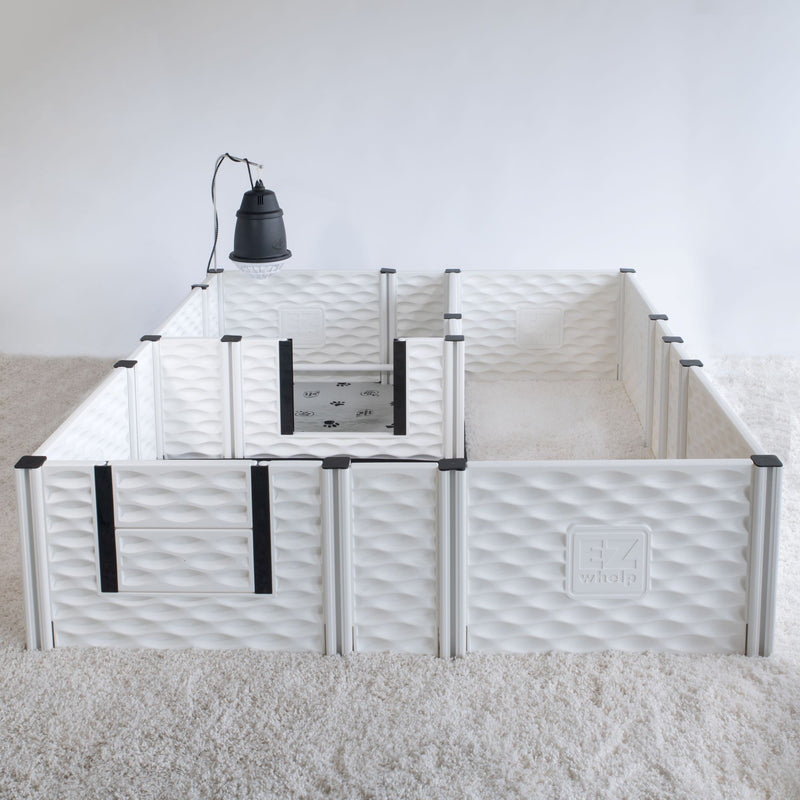
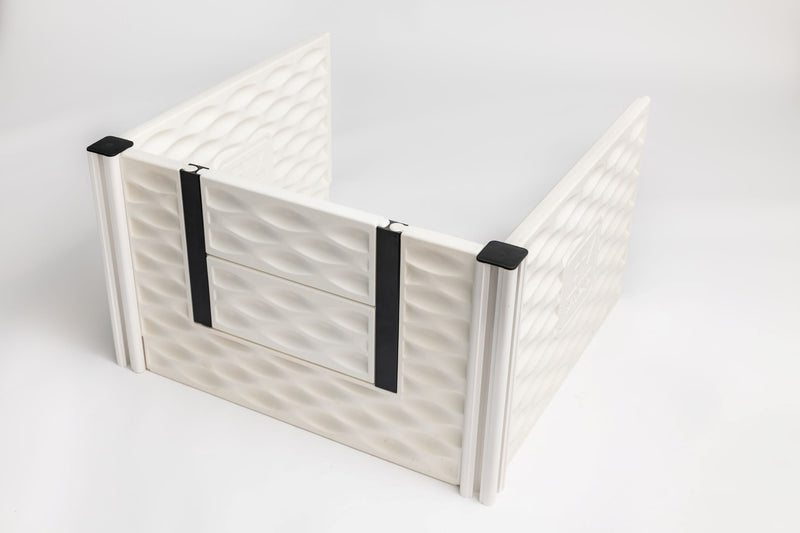
Room for the litter to grow
Affiliate disclosure: Breeder Lab may earn a commission from EZwhelp purchases made through these links, at no extra cost to you.

Not sure which size or bundle?
Five questions. We fill in what you've already told us.
Learn
Puppy growth calculator
How big he’ll be grown — and the question that matters more, whether he’s growing too fast to get there safely.
How big will my puppy get?
Take his weight today, divide it by the share of adult weight typical for his age and size class, and allow ten percent either side. That is the whole method. Size class matters far more than breed — a size band covers every dog, including crosses, which is why breed here only pre-fills the band.
Puppy weight chart by size — birth to 24 months
Percentage of adult weight reached, by size class. Every figure the tool uses comes from this table.
| Age | Toy | Small | Medium | Large | Giant |
|---|---|---|---|---|---|
| 8 weeks | 30% | 27% | 22% | 16% | 14% |
| 3 months | 50% | 45% | 40% | 30% | 25% |
| 4 months | 60% | 55% | 50% | 42% | 33% |
| 6 months | 80% | 75% | 70% | 65% | 45% |
| 9 months | 96% | 92% | 88% | 82% | 65% |
| 12 months | 100% | 98% | 95% | 92% | 78% |
| 18 months | 100% | 100% | 100% | 97% | 90% |
| 24 months | 100% | 100% | 100% | 100% | 100% |
Growing too fast: what it costs a large-breed puppy
A puppy at the middle of the curve on proper nutrition ends up at the same adult weight as a fast-grown, top-of-the-curve puppy — with substantially better joint outcomes. Growing fast doesn’t make a bigger dog. It makes the same dog with worse joints.
Rapid growth can affect developing joints. Ask your veterinarian to recommend an appropriate complete diet, body-condition target, and whether any supplement is appropriate for the individual puppy. Do not add calcium or vitamin D unless the veterinarian directs it.
How to work out adult weight without a calculator
These multipliers are derived from the table above, so they cannot contradict it. Most published rules of thumb do.
| At | Multiply by |
|---|---|
| 14 weeks, medium breed | × 2.35 |
| 6 months, toy | × 1.25 |
| 6 months, small | × 1.33 |
| 6 months, medium | × 1.43 |
| 6 months, large | × 1.54 |
| 6 months, giant | × 2.22 |
Printable
Puppy weight chart
Daily weights for the first two weeks, weekly weights to go-home.
Download the sheetFrequently asked
Divide his current weight by the percentage of adult weight typical for his age and size class, then allow ten percent either side. A large-breed puppy is about 65% of his adult weight at six months, so a 45 lb Labrador at six months is heading for roughly 62 to 76 lb.
No. A puppy at the middle of the curve on proper nutrition reaches the same adult weight as a fast-grown puppy, with substantially better joint outcomes. Rapid growth outpaces joint cartilage maturation, so the cartilage cannot keep up with bone elongation.
About 80% for toy, 75% small, 70% medium, 65% large and 45% giant. Sources put large breeds anywhere from 55% to 69% at six months; this tool uses 65%, in line with the WALTHAM data.
Calculators of this type are accurate to within ten to twenty percent. A range of plus or minus ten percent is more honest than a single figure, and no percentile is shown because a percentile needs a distribution these charts do not provide.